Imam Bayildi: Eggplant Braised in Olive Oil for the Fast
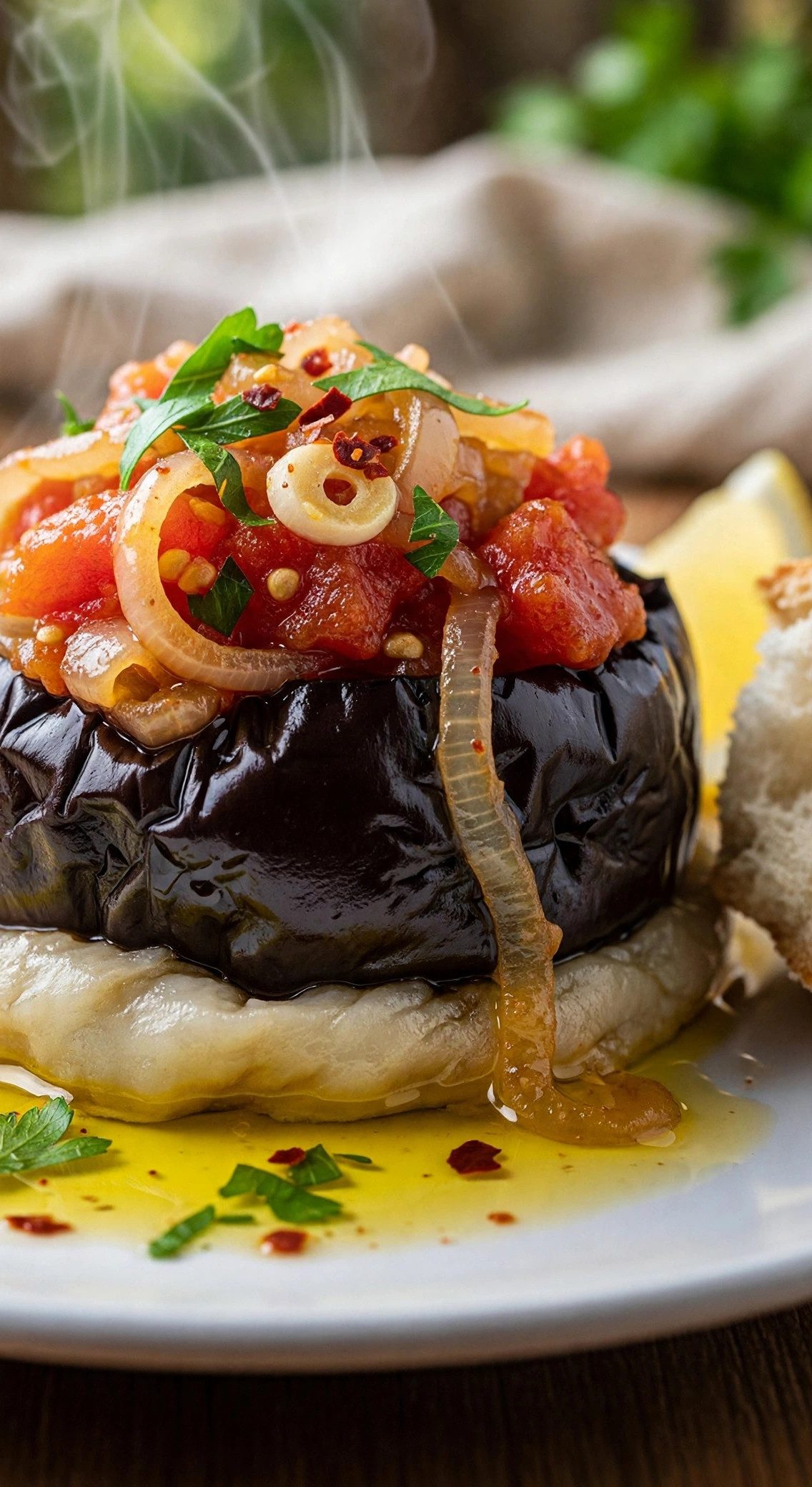
Legend says the imam fainted — from pleasure, or from shock at how much olive oil went into the dish. Either way, imam bayildi has been the poster child of olive-oil cooking for centuries: eggplants roasted soft, hollowed into boats, heaped with a filling of slowly caramelised onions and tomatoes, and braised in enough olive oil to make a sauce you will fight over with bread. It is Turkish in origin, pan-Orthodox in practice, and entirely, naturally a fasting dish.
No adaptation is needed — only restraint at the serving table. The dairy finish some modern recipes suggest — a spoonful of yogurt or a crumble of feta — is not part of this dish and has no place on a fast day. Made as written here, with the traditional filling and nothing else, imam bayildi is wine-and-oil day cooking at its most generous: a main dish for a Saturday in Lent, or a feast-day table.
Ingredients
- 4 medium eggplants (about 225–250 g each)
- 1½ tsp kosher salt, for salting the eggplants
- 1¼ cups extra-virgin olive oil, divided
- 3 large yellow onions, thinly sliced (about 700 g)
- 6 garlic cloves, finely minced
- 2 medium very ripe tomatoes, diced — or one 400 g can diced tomatoes, drained
- 2 tbsp tomato paste
- 1 tsp sugar
- 1 tsp fine sea salt, plus more to taste
- ½ tsp freshly ground black pepper
- ½ tsp red pepper flakes (optional)
- ½ cup chopped fresh flat-leaf parsley
- Juice of ½ lemon
- 1 cup water
- 1 bay leaf (optional)
Method
- Halve the eggplants lengthwise, keeping the stems on. Score the cut flesh in a shallow crosshatch, being careful not to pierce the skin. Sprinkle the cut sides generously with the 1½ teaspoons kosher salt and let them sit for 15 minutes, then blot away the beaded moisture with paper towels.
- Heat the oven to 220°C (425°F). Brush the cut sides with 4 tablespoons of the olive oil, getting it into the scored cuts. Roast cut-side up on a parchment-lined tray for 25–30 minutes, until very soft, lightly browned and easily pierced with a fork. Reduce the oven to 180°C (350°F).
- While the eggplants roast, make the filling. Warm ½ cup of the olive oil in a large, wide pan over medium-low heat. Add the onions with a pinch of salt and cook, stirring every few minutes, for 15–20 minutes, until very soft, golden and beginning to caramelise — do not rush this step; the slow sweetness of the onions is the dish.
- Stir in the garlic and cook for 1–2 minutes, until fragrant. Add the tomatoes, tomato paste, sugar, the 1 teaspoon sea salt, black pepper and red pepper flakes (if using). Simmer for 5–7 minutes, until the mixture thickens into a chunky, glossy sauce. Take off the heat and fold in the parsley and lemon juice. Taste and adjust.
- Set the roasted eggplants in a snug baking dish. Press down the centre of each half to form a boat (gently scoop a little flesh if needed — chop any scooped flesh and stir it into the filling). Heap the filling generously into each boat.
- Mix the remaining ¼ cup olive oil with the water and pour it around the eggplants — not over them — so the liquid comes about a quarter of the way up their sides. Tuck in the bay leaf, cover tightly with foil, and braise for 30–35 minutes, until the eggplants are completely tender and the olive oil–tomato juices bubble around the sides.
- Remove the foil and rest the dish for at least 15–20 minutes. Spoon the pan juices over each eggplant and serve warm or at room temperature, with plenty of crusty bread for the sauce.
Rule source: Orthodox fasting rule per the Typikon (chs. 32–33), as published in OCA and GOARCH fasting guidance: on a wine-and-oil day, meat, dairy, eggs and fish are still set aside, but wine and olive oil are permitted.
Notes
- The onions are the dish. Fifteen to twenty unhurried minutes, low heat, no browning — if they start to catch, a splash of water and the heat down. Rushing this step costs the dish its sweetness.
- Oil is a flavour carrier here. Use a good extra-virgin olive oil and do not skimp; the braising oil becomes the sauce you mop up with bread. This is an oil-day dish by construction.
- Serve warm or at room temperature, not piping hot — the rest after baking lets the flavours settle and the oil turn glossy.
- No dairy finish. The source itself labels the yogurt-or-feta version "not traditional"; on a fast day it is also not permitted, and our record omits it.
- Make-ahead. Improves with a few hours' rest; keeps 4 days in the fridge. Leftovers are excellent tucked into flatbreads.
- Chickpea variation. Stir a cup of cooked chickpeas into the filling for a heartier dish.
Frequently asked questions
When can I eat imam bayildi during the fast?
On wine-and-oil days. Everything in the dish is vegetable except the olive oil — which is precisely the ingredient a wine-and-oil day permits.
Can I use one large eggplant instead of medium ones?
Medium, slender eggplants roast more evenly and have fewer seeds. If you only have large ones, quarter them lengthwise rather than halving.
Is this dish Turkish or Greek?
Turkish in origin — the name means "the imam fainted" — and shared across the Ottoman world, including Greece and the Levant, where Orthodox households have cooked it for generations. Fasting food has always crossed borders. ---