Briam: Greek Roasted Vegetables for the Lenten Table
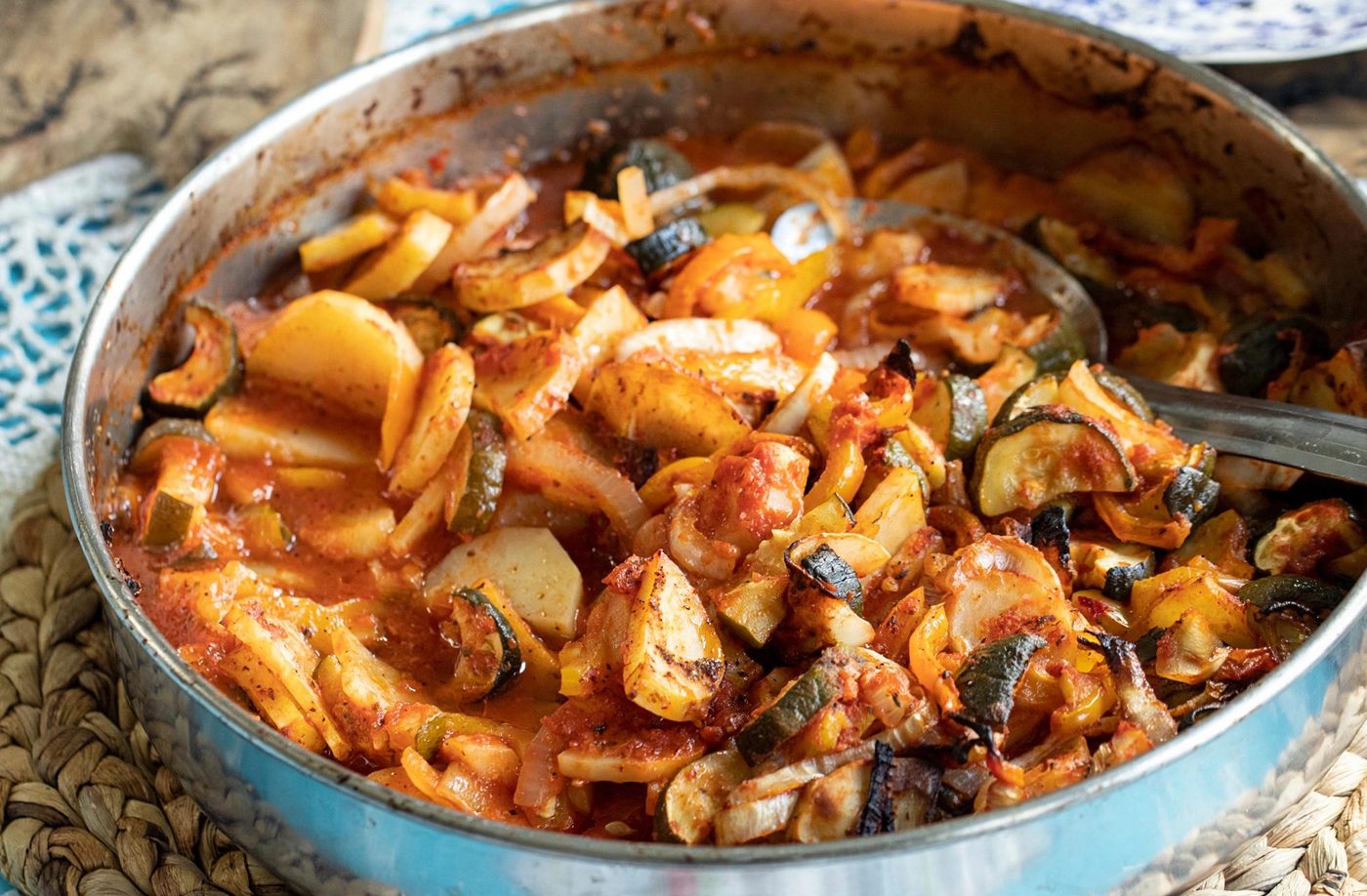
Briam is Greece's ratatouille — zucchini, potatoes, peppers and onion, sliced thick, tumbled with tomato and olive oil, and roasted until the edges caramelise and the sauce thickens into something you mop up with bread. It is the end-of-summer dish and the clean-out-the-drawer dish, and during the fasts it is one of the easiest mains: a pan, a hot oven, and an hour and a half you spend doing something else while the vegetables turn to silk.
Two rules make it work: slice the vegetables thick enough to survive the roast — zucchini cut too thin collapses into mush — and wait for the potatoes. Everything else in the pan is tender long before they are; the dish is done when a fork says so, not the timer. This belongs to the wine-and-oil days, when the oil comes back to the kitchen: a Saturday in Lent, eaten with appetite.
Ingredients
- 1 onion, sliced into half-moons
- 3 zucchini, sliced into thick half-moons
- 4 baking potatoes, sliced about 1 cm thick
- 2 bell peppers, sliced into rings
- ¼ cup olive oil, or a little more
- 1 tsp dried oregano
- 800 g (28–30 oz) crushed tomatoes
- 2–3 roasted red peppers
- ½ tsp granulated sugar
- 1 tsp fine salt, or to taste
- Freshly cracked black pepper, to taste
- ¼ tsp crushed red pepper flakes (optional)
Method
- Heat the oven to 200°C (400°F).
- Put all the sliced vegetables in a 9×13-inch (23×33 cm) roasting pan. Drizzle with the olive oil and season lightly with the salt, black pepper and oregano.
- Combine the crushed tomatoes, roasted red peppers, sugar, salt, black pepper and red pepper flakes (if using) in a blender and blend until smooth. Taste and adjust the seasoning.
- Pour the sauce over the vegetables and toss so everything is evenly coated — you want the sauce distributed, not pooled at one end.
- Cover the pan tightly with foil and bake for 45 minutes.
- Uncover and bake for another 45 minutes, until the sauce has thickened and the vegetables — especially the potatoes — are completely fork-tender.
- For a little more colour, slide the pan under the broiler for about 5 minutes. Rest briefly, then serve with plenty of bread.
Rule source: Orthodox fasting rule per the Typikon (chs. 32–33), as published in OCA and GOARCH fasting guidance: on a wine-and-oil day, meat, dairy, eggs and fish are still set aside, but wine and olive oil are permitted.
Notes
- Cut thick, especially the zucchini. Thin slices disintegrate over 90 minutes. Half-moons of at least a centimetre hold their shape and stay creamy inside.
- The potatoes decide. Test them, not the zucchini. If the potatoes are still firm after 90 minutes, give the pan another 15 — a pale potato ruins the dish.
- A touch of sugar. The half-teaspoon rounds off canned tomatoes' acidity; roasted red peppers add their own sweetness to the sauce.
- No feta. A hunk of feta beside the pan is the source's suggestion for ordinary days. On a fast day it stays in the fridge — and out of the photo.
- Storage. Keeps 4–5 days in the fridge; the leftovers make an excellent vegetable soup the next day.
Frequently asked questions
When can I eat briam during the fast?
On wine-and-oil days — Saturdays and Sundays in the fasts, and feast-day relaxations. There is no meat, dairy, egg or fish in the dish; the olive oil sets its level.
Can I use different vegetables?
Yes. Briam is a template: eggplant and summer squash are the classic swaps. Keep the proportions roughly the same and the sauce recipe unchanged.
Why cover it for the first half?
The foil steams the potatoes through before the uncovered half browns and thickens everything. Uncovered from the start, the top dries out before the potatoes are done. ---