Who Was the Buddha? The Life of Siddhartha Gautama
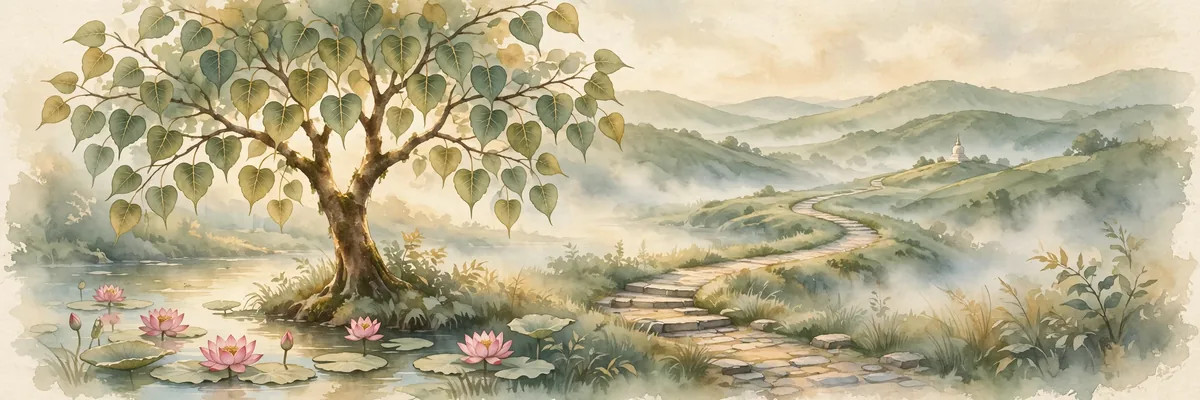
Who was the Buddha — a god, a philosopher, or a man? It is the right first question, because Buddhism itself gives a clear answer: he was a human being named Siddhartha Gautama, who lived in northern India roughly two and a half thousand years ago, woke up to the truth about suffering and its end, and spent his life teaching others the way he had found. "Buddha" is not his name. It is a title, meaning "the Awakened One" — and Buddhists do not worship him as a creator god. Here is his life, told as the tradition tells it.
A sheltered prince
Siddhartha Gautama was born, tradition says, in Lumbini, in present-day Nepal, son of a king of the Shakya clan. The traditional accounts surround his birth with wonders — dreams and omens of an extraordinary child — recounted as sacred story, the way communities have handed them down ever since.
One prediction shaped his childhood: seers said the boy would become either a great king or a great spiritual teacher. His father, wanting an heir rather than a monk, chose the palace. He raised Siddhartha in comfort, shielded from anything painful — sickness, age, and death were kept outside the palace walls — and the young prince grew up skilled, married, and quietly unfulfilled.
The four sights
The turning point of the story is famous. On excursions outside the palace, the tradition tells, Siddhartha encountered four sights his father had hidden from him. He saw an old man, bent and frail, and learned that everyone ages. He saw a person wracked with sickness, and learned that no wealth prevents illness. He saw a corpse, and learned that everyone, even a prince, dies.
Then he saw a fourth sight: a wandering ascetic who had given up home and possessions to seek an answer to suffering — poor by every worldly measure, and yet calm. The prince went home with a question comfort could no longer silence: if old age, sickness, and death come for everyone, what is a life for?
Leaving the palace
At about twenty-nine, with a newborn son at home, Siddhartha made the decision the tradition calls the Great Departure. He left the palace at night, cut off his hair, exchanged his clothes for a wanderer's robes, and set out to find the end of suffering — not only for himself, but for everyone the four sights had shown him.
For around six years he studied with renowned teachers, mastering their meditations, and still found they did not reach the root of the problem. Then he joined ascetics practising extreme self-denial — fasting until his body was skeletal — on the theory that punishing the body would free the spirit. That, too, failed, and it nearly killed him.
The middle way
From those years came one of his most important discoveries: the middle way. A life drowned in pleasure does not wake up — the palace had proved that. But a starved, broken body cannot think clearly either. Between indulgence and self-punishment lies a middle path of balance and steady attention, and he decided to walk it.
Accepting a simple meal of rice to restore his strength — to the dismay of his companions, who left him — he sat beneath a fig tree at Bodh Gaya, in present-day India, and resolved not to rise until he understood.
Awakening under the Bodhi tree
The traditional accounts describe the night that followed in vivid terms: temptations and fears assailing the seated figure like an army, and Siddhartha answering not with force but with stillness, touching the earth as his witness. However each detail is read, Buddhists have always been clear about what the night means.
By dawn, he had awakened. He saw, the tradition says, how suffering arises — from craving, clinging, and misunderstanding the way things are — and that it can end, because what arises from causes can cease when its causes cease. The fig tree became known as the Bodhi tree, the tree of awakening, and Siddhartha became the Buddha: the Awakened One.
He was about thirty-five. He had not become a god, and never claimed to be one. He described himself, in effect, as a man who had been asleep and had woken up — and who could show others how.
The first sermon at Sarnath
After a period of reflection, the Buddha walked to Sarnath, near present-day Varanasi, where his five former companions were living. There, in a deer park, he preached his first sermon, known as the Setting in Motion of the Wheel of Dharma.
In it he set out the heart of his teaching: the middle way, and the Four Noble Truths — that life involves suffering, that suffering has a cause, that it can end, and that there is a path to its end, the Noble Eightfold Path. His companions became his first disciples, and the community, the Sangha, began.
Forty-five years of teaching
What follows is not a retreat from the world but a life spent walking through it. For forty-five years the Buddha travelled northern India on foot, teaching anyone who would listen — kings and farmers, merchants and outcasts, monks and householders. He founded communities of monks and, after persuading, of nuns, taught in the local language rather than the scholars' Sanskrit, and turned no sincere questioner away.
The picture the tradition preserves is of a teacher of patience and humour whose message never wavered: suffering can be understood, its causes can be let go, and the way is walked step by step, by each person for themselves. No one, he insisted, could do the walking for you.
Faith Map's Buddhist lessons follow that teaching from the Four Noble Truths onward, are free to read, and sit alongside a simple sitting timer for anyone beginning a meditation practice.
Parinirvana at Kushinagar
At about eighty, after a final season of teaching, the Buddha fell ill and lay down between two trees at Kushinagar, in present-day Uttar Pradesh, surrounded by his monks. The tradition calls his death parinirvana — a final passing beyond rebirth — and remembers his last instruction as encouragement rather than farewell: all compounded things decay, so strive on with diligence.
His body was cremated, and his relics were enshrined in stupas across the region — the starting point of a tradition that would spread across Asia and, eventually, the world.
Vesak: one day, three events
Buddhists mark the whole arc of his life on a single festival. Vesak, kept on the full moon of the month of Vesakha — usually in May — is traditionally observed as the anniversary of the Buddha's birth, his awakening, and his parinirvana, all three. Temples are decorated, lamps are lit, and devotees visit monasteries, give generously, and renew their commitment to his teaching.
It is a fitting summary of how Buddhists see him: not a god descending to earth, but a human life that began in a palace, asked the hardest questions, and became a lamp for others.
Frequently asked questions
Was the Buddha a god?
No. Buddhists do not worship the Buddha as a creator god, and he did not present himself as one; he was a human teacher who awakened through his own effort and taught that others could follow the same path — honoured as an example and guide rather than a deity.
What does the word "Buddha" mean?
"Buddha" is a title, not a personal name, from a root meaning to wake up; it means "the Awakened One." Siddhartha Gautama is the Buddha most people mean — the historical founder — though traditions also speak of other Buddhas across vast stretches of time.
What is the middle way in Buddhism?
The middle way is the path between two extremes the Buddha tested himself: a life lost in indulgence, like his palace years, and harsh self-denial, like his years of fasting. It describes both his balanced approach to practice and, in his teaching, the Noble Eightfold Path itself.