What Is Vesak? Buddha Day Explained
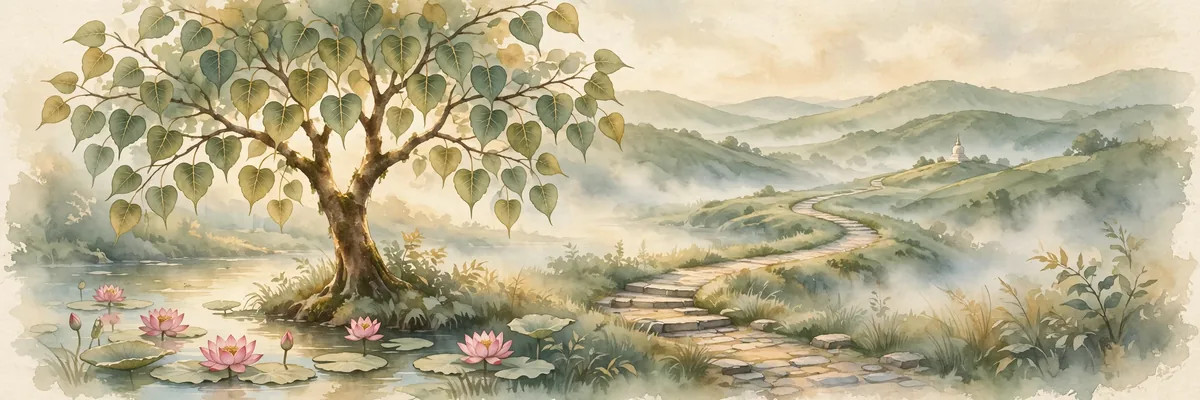
On one full-moon night a year, temples fill with candlelight, statues of an infant Buddha are bathed with water, and people who might not set foot in a temple all year dress in white and keep a quieter, kinder day. Why that moon, and why does a single date carry so much weight?
That day is Vesak, often called Buddha Day. It is the most widely observed festival in the Buddhist world, and unusually, it does not mark one event. In tradition, it marks three.
Three events on one full moon
Buddhist tradition holds that the three defining moments of the Buddha's life all fell on the same full-moon day, in different years of his life.
The first is his birth at Lumbini, in present-day Nepal, where Queen Maya gave birth to Siddhartha Gautama, the child who would become the Buddha. The second, thirty-five years later in the traditional telling, is his awakening at Bodh Gaya, in present-day India: after a night of meditation beneath the Bodhi tree, he understood the nature of suffering and its end, and became the Buddha, the Awakened One. The third is his parinirvana at Kushinagar, also in present-day India — his final passing at the age of eighty, when, having taught for forty-five years, he left the cycle of rebirth behind.
Birth, awakening, and death on a single date give Vesak its particular character. It is a celebration, but a reflective one: the festival holds a whole life, from beginning to end, in one evening's moonlight, and invites the people keeping it to consider their own lives in the same light.
When is Vesak?
Vesak falls on the full moon of the month of Vesakha in the traditional lunar calendar, which in most years lands in May. Because lunar calendars and local conventions differ, the exact date is not identical everywhere, and some traditions and some years differ from their neighbours by a day, or even by a month in leap-year calculations. In several East Asian Mahayana traditions, the Buddha's birthday is kept on a separate fixed date in the lunar calendar, so Vesak observances there may look different in emphasis and timing.
If you are planning to visit a temple, check its own calendar rather than assuming the date used in the next country, or the next town.
How Vesak is kept
At the temple
The centre of the day is the temple visit. People bring offerings of flowers, candles, and incense, and each offering carries a meaning worth knowing. Fresh flowers, beautiful in the morning and fading by evening, symbolise impermanence: everything that arises also passes, including the life being honoured. Candles and lamps stand for light and wisdom, the understanding that dispels the darkness of ignorance. Incense, spreading quietly through the hall, represents a wholesome life whose influence reaches beyond itself.
There are sermons and chanting, meditation sits, and in many places circumambulation of a stupa or shrine. The mood is festive but unhurried, closer to a family gathering at a place everyone loves than to a performance.
Bathing the Buddha
In a number of East Asian traditions, and in communities shaped by them, Vesak includes bathing a small standing statue of the infant Buddha. The figure stands in a basin, one hand pointing to the sky and one to the earth, and worshippers ladle water gently over it, usually three pourings. The act is understood as an offering and as a reminder to purify one's own actions, speech, and thoughts — washing the statue while resolving to clean up one's own conduct.
Generosity and the precepts
Vesak is a major day for dana, generosity. People give food to monks and nuns, donate to temples and charities, give blood, and look for practical ways to be useful. Giving is not an add-on to the festival; in Buddhist teaching it is one of the basic ways a wholesome life is built.
Many laypeople also observe the precepts more strictly for the day. Some keep the usual five precepts with extra care; others take on the eight precepts, which add practices such as not eating after midday and abstaining from entertainment and adornment, spending the day almost as a temporary monastic does. In Sri Lanka and other Theravada countries, this is visibly marked: devotees dress in white, temples and homes fill with white-clad families, and the day is kept quietly, with alcohol shops and butchers often closed by custom or law.
Vegetarian meals are common across traditions on Vesak, an expression of compassion for living beings. Some communities have traditionally released captive animals as an act of merit; that practice is debated, including among Buddhists, because released animals may not survive or may harm local ecosystems. Many temples now steer people toward vegetarian meals, dana, and other forms of giving instead, and those alternatives are what a visiting guest is most likely to encounter.
Lanterns in Korea
In South Korea, Vesak — the Buddha's birthday there — is lit by Yeondeunghoe, the Lotus Lantern Festival. Thousands of handmade lanterns, lotus-shaped and in every colour, are hung at temples and carried in procession through Seoul, with lantern exhibitions and events running for days around the festival itself. The lotus, rising clean out of muddy water, is a natural emblem for awakening, and a city street full of lanterns is many visitors' first sight of Vesak anywhere.
A day recognised worldwide
In 1999, the United Nations formally recognised Vesak as an international observance, acknowledging the contribution of Buddhism, one of the world's oldest religions, to the spiritual life of humanity. UN offices hold their own observances of the day, alongside the millions keeping it in temples, homes, and lantern-lit streets.
If you would like to understand the life being celebrated before you go, the Buddhism lessons in Faith Map are free to read, from the Buddha's story to the teachings that came out of that night under the Bodhi tree. Reading and lessons are free; listening to chapter narration is a Plus feature, if you prefer to hear the texts read aloud.
Go to a temple on Vesak if you are invited, or if the doors are open, as they usually are. Bring nothing more complicated than flowers if you like, dress modestly, and expect to be handed a candle. Your faith is beautiful, and on this of all days, Buddhists are glad to show you why theirs is too.
Frequently asked questions
Why does Vesak celebrate three events at once?
Buddhist tradition holds that the Buddha's birth at Lumbini, his awakening at Bodh Gaya, and his parinirvana at Kushinagar all occurred on the same full-moon day in different years, so Vesak honours the whole arc of his life on a single date.
When is Vesak celebrated?
Vesak falls on the full moon of the lunar month of Vesakha, which is usually in May, though the exact date varies between countries and traditions because lunar calendars and leap-month conventions differ, so temples publish their own dates each year.
What do the flowers, candles, and incense at Vesak mean?
The offerings are symbolic: flowers represent impermanence, since they fade within days; candles stand for the light of wisdom dispelling ignorance; and incense represents a wholesome life whose good influence spreads quietly to others.