Hot Cross Buns: The Traditional Bake for Catholic Good Friday
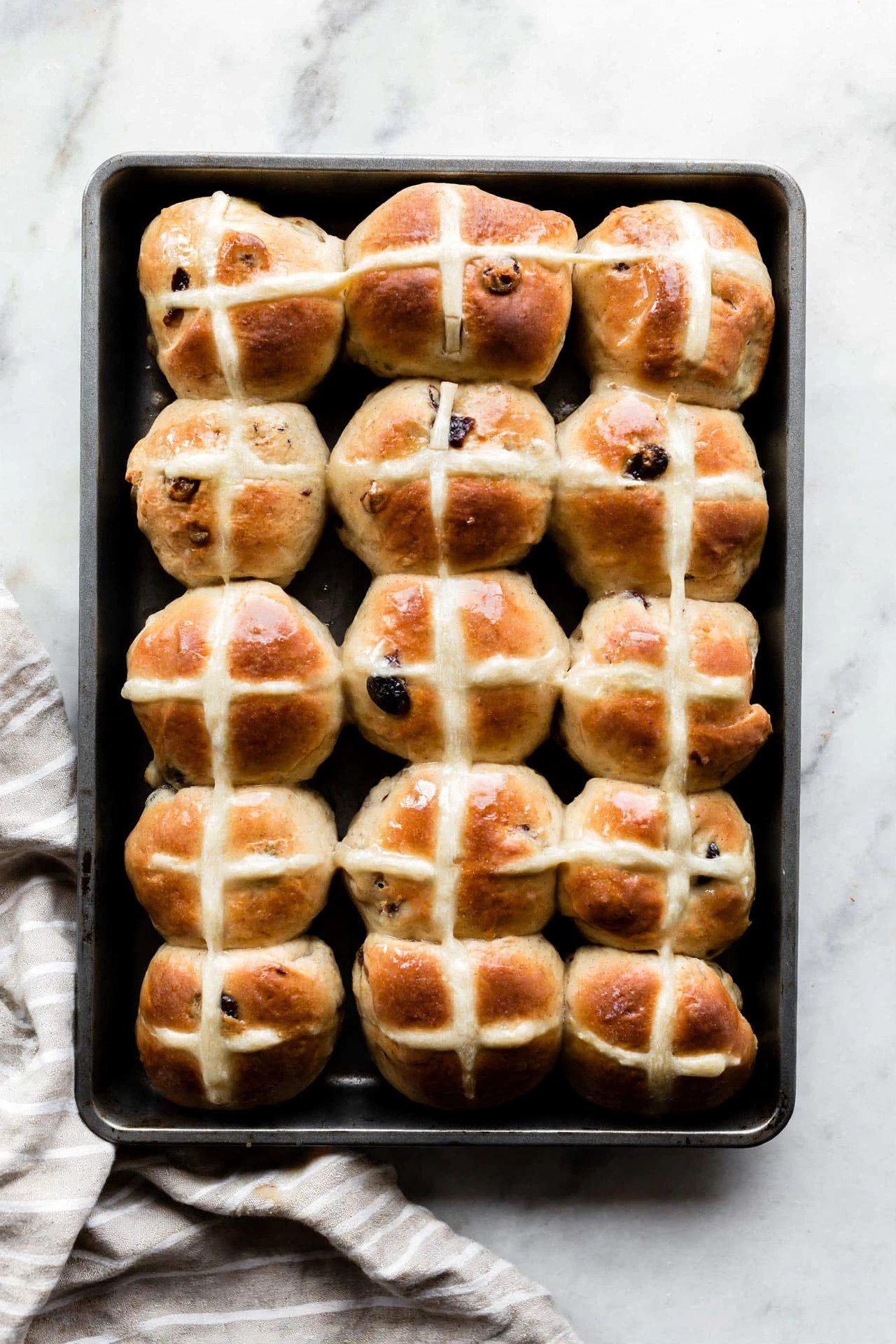
Of all the foods Lent has produced, the hot cross bun may be the oldest still on the table: a spiced yeast bun, studded with raisins or currants, marked with a cross, and eaten on Good Friday. The tradition reaches back centuries in England — a bun for the one day of the year when the Church's fast was at its most solemn, its cross piped in flour paste before baking so that even the bread of the day carried the sign of it.
It is important to be clear about what the bun is, because this collection tags things carefully. The hot cross bun is not a fast-breaking indulgence and it is not presented here as a meal: it is the customary food of the day itself, eaten in households that are keeping the Good Friday fast around it — traditionally with the day's one meal, or as the small thing that accompanies it. Its ingredients ask no permission: flour, milk, butter, eggs and sugar are all permitted on a day of abstinence, eggs and dairy expressly so. What the bun asks for is time — a spiced dough, two rises, and a piping bag — and it repays it in the smell alone: cinnamon, nutmeg and allspice through a quiet house on the quietest morning of the year. Bake them on Good Friday, as they were meant to be baked, and eat them warm with the orange icing still glossy.
Ingredients
- 3/4 cup (180 ml) whole milk, warmed to about 43°C (110°F)
- 2 1/4 tsp active dry or instant yeast (1 standard packet)
- 1 tsp granulated sugar
- 1/2 cup (100 g) packed light or dark brown sugar
- 5 tbsp (71 g) unsalted butter, softened and cut into pieces
- 1/2 tsp pure vanilla extract
- 2 large eggs, at room temperature
- 1 tsp salt
- 1 1/4 tsp ground cinnamon
- 1/2 tsp ground nutmeg
- 1/2 tsp ground allspice
- 3 1/2 cups (438 g) all-purpose or bread flour, spooned and levelled
- 1 cup (140 g) raisins or currants
- For the flour cross: 1/2 cup (63 g) all-purpose or bread flour
- For the flour cross: 6–8 tbsp (90–120 ml) water
- For the orange icing: 1 cup (120 g) confectioners' sugar
- For the orange icing: 3 tbsp (45 ml) orange juice
Method
- Whisk the warm milk, yeast and granulated sugar together in the bowl of a stand mixer (or a large mixing bowl). Cover and leave for about 5 minutes, until foamy on top.
- Add the brown sugar, butter, vanilla, eggs, salt, cinnamon, nutmeg, allspice and 1 cup (125 g) of the flour. Mix on low for 30 seconds, scrape the bowl down, then add the remaining flour and the raisins. Mix until the dough comes together and pulls away from the sides, about 2 minutes — soft and a little sticky is right.
- Knead for 5 full minutes, in the mixer or by hand on a lightly floured surface, adding flour a teaspoon at a time only if the dough is too sticky to handle. It is ready when it is smooth, soft, and slowly springs back when poked.
- First rise: place the dough in a lightly greased bowl, turning it to coat, cover, and leave in a warm place until doubled, 1–2 hours.
- Grease a 23 × 33 cm (9 × 13-inch) baking pan. Punch the dough down and divide it into 14–16 equal pieces. Roll each into a smooth ball, pinching and sealing the bottom, and arrange them in the pan.
- Second rise: cover the shaped buns and leave until puffy, about 1 hour. Near the end, heat the oven to 177°C (350°F).
- Make the cross paste: whisk the 1/2 cup of flour with 6 tablespoons of the water into a thick, pipeable paste, adding the rest of the water only if needed. Spoon it into a piping bag or a zip-top bag with a small corner snipped off, and pipe a line down the centre of each row of buns, then across, to form the crosses.
- Bake for 20–25 minutes, until golden brown on top, rotating the pan halfway. If the tops colour too fast, tent loosely with foil.
- Whisk the confectioners' sugar and orange juice into an icing and brush or drizzle it over the warm buns. Serve warm if you can.
Rule source: Catholic abstinence rule: Code of Canon Law c. 1251 and the USCCB norms — on Good Friday, a day of fasting and abstinence, the meat of land animals and birds is excluded, while dairy and eggs are permitted. Hot cross buns are the day's customary bake; they are food for the feast's edge of the fast, not a substitute for its meal.
Notes
- Two ways to make the cross. The flour-paste cross in this recipe is piped on before baking and is the most traditional; it bakes up pale and slightly chewy. The alternative is an icing cross piped on after baking: skip the paste, glaze nothing, and make the icing thick with just 1 tablespoon of orange juice so it holds its lines.
- Plump the raisins. Ten minutes in hot water before they go into the dough keeps them moist through the bake. Dried cranberries, chopped candied peel or dried apricots all work in their place — keep the total around 1 3/4 cups.
- Make them ahead. Shape the buns, cover tightly and refrigerate up to about 15 hours; let them rise on the counter for 1–2 hours before baking. Or freeze the shaped, unbaked buns for up to 3 months, then thaw and rise for 4–5 hours on the day. Baked buns freeze well too — ice them after reheating.
- Cinnamon slows a rise. The full 1 1/4 teaspoons is what makes these dense, close-textured buns rather than fluffy rolls. For a lighter bun, cut it to 1/2 teaspoon.
- Storage. Covered, they keep 1–2 days at room temperature and up to a week in the fridge. A few seconds in a warm oven or toaster brings them back.
Frequently asked questions
Why are hot cross buns eaten on Good Friday?
By long English tradition: a spiced bun marked with the cross, baked for the day of the Crucifixion. The custom is documented for centuries, and the bun became so bound to the day that it is still the food most associated with Good Friday in Britain and the Commonwealth.
Are they allowed while keeping the Good Friday fast?
The ingredients are all permitted on a day of abstinence — dairy and eggs expressly are. The fast itself concerns how much is eaten: one full meal and two smaller ones. A bun belongs to the day as its customary bake; it isn't a loophole in the fast and isn't presented as one here.
Can I use currants instead of raisins?
Yes — currants are the older, more traditional fruit for these buns. Raisins are simply easier to find. Either plumps and bakes the same way. ---