Baptism Explained: What Christians Believe About Baptism
Ask a room of Christians what baptism means and you will get answers that agree on more than you might expect — and differ, sometimes sharply, on a handful of real questions. Who should be baptized? How much water, and applied how? What is happening in the moment itself?
This guide does not referee those differences. Instead it lays out what nearly all Christians share, then presents each major practice the way its own adherents understand it. Baptism is a deeply meaningful step in Christian life, and every tradition here takes the water seriously.
The shared root: John, Jesus, and the command
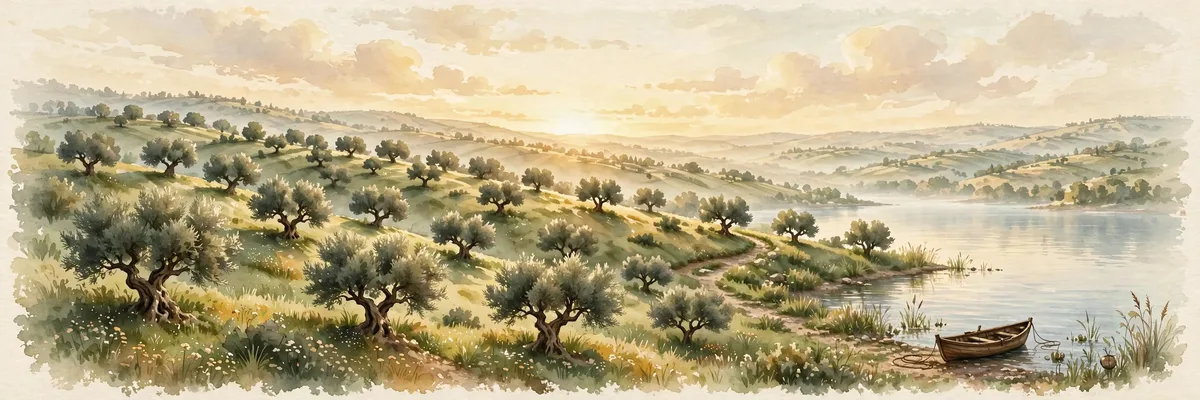
Baptism begins in the Jordan River. In the Gospels, John the Baptist calls people to repentance and baptizes them in the river, and Jesus himself comes to John to be baptized — an event recorded in all four Gospels, in which the heavens open and a voice speaks as Jesus comes up from the water. Every tradition traces baptism back to that river: it is the pattern and starting point for the practice.
At the end of Matthew's Gospel, the risen Jesus gives his followers their commission, and baptism stands at its center:
Go ye therefore, and teach all nations, baptizing them in the name of the Father, and of the Son, and of the Holy Ghost:
Matthew 28:19 (KJV)
From those words come the elements nearly every baptism everywhere still shares: water, and baptism into the name of the Father, the Son, and the Holy Spirit. The earliest Christians baptized widely, and baptism quickly became the doorway into the Christian community — the public mark of belonging to Christ and to his church. On almost everything that follows, though, faithful Christians reading the same Scriptures have come to different conclusions, and held them for centuries.
Believer's baptism: a profession of faith
Baptist churches, most evangelical and Pentecostal churches, and many independent churches practice what is often called believer's baptism, or credobaptism. In this understanding, baptism follows a personal decision: a person hears the gospel, repents, and professes faith in Christ — and then is baptized. The order matters. Baptism, in this view, is an outward testimony to an inward change that has already taken place, a public declaration that the person now belongs to Christ.
Because baptism is a personal profession, these churches baptize only those old enough to make that profession for themselves. They do not baptize infants — many instead hold dedication services, presenting a child to the congregation's prayers — because, in their reading of Scripture, baptism belongs to believers.
The usual mode is immersion: the person goes fully under the water and is raised back up. Adherents connect this with the word baptize itself, drawn from a Greek word for dipping or immersing, and with the picture in Romans 6 of burial and resurrection. Many such churches have a baptistery in the sanctuary; others baptize in rivers and lakes, closer to the Jordan pattern.
Infant baptism: covenant and new birth
Roman Catholic, Eastern Orthodox, Lutheran, Anglican, Methodist, Presbyterian, and many other churches baptize infants as well as adult converts — a practice often called paedobaptism. The reasoning generally runs on one or both of two tracks.
The first is covenant. Presbyterian and many Reformed and Methodist teachers point to the covenant promises of the Old Testament, in which the children of believers were included in God's covenant people and received its sign. In this framing, baptism is the sign of that same covenant now extended to children: the child is received into the visible church on the strength of God's promise, and the parents and congregation promise to raise the child in the faith, with the hope of the child's own profession of faith later — often marked by confirmation.
The second track is new birth. Catholic and Lutheran teaching holds that baptism itself is a means of grace through which God acts: in Catholic teaching, baptism washes away original sin and makes the baptized a child of God and member of the Church; Lutherans similarly speak of baptism as God's own work of forgiveness and rebirth, which is precisely why it is not withheld from infants.
How the water is given
Three modes appear across the traditions. Immersion places the whole person under the water. Pouring, sometimes called affusion, pours water over the head — the usual practice for Catholic and many mainline Protestant baptisms, whether of infants or adults. Sprinkling, or aspersion, uses a smaller amount of water and appears in some Methodist, Presbyterian, and other settings, often for practical reasons such as illness.
The Orthodox Church baptizes infants by threefold immersion — the baby is fully immersed three times, in the name of the Father, Son, and Holy Spirit — and immediately follows baptism with chrismation, an anointing with holy chrism through which, in Orthodox teaching, the gift of the Holy Spirit is sealed. The newly baptized infant then receives communion. Baptism, chrismation, and first communion, which the West spread across childhood, arrive together in a single service.
Latter-day Saint and Jehovah's Witness baptism
Two further traditions hold distinctive teachings, best stated in their own terms. In The Church of Jesus Christ of Latter-day Saints, baptism is by immersion, performed by one holding priesthood authority, and it is required for membership and, in Latter-day Saint teaching, for entering the celestial kingdom. Children are baptized at age eight, understood as the age of accountability; younger children are considered innocent and are not baptized. A baptism is followed by confirmation and the laying on of hands for the gift of the Holy Ghost.
Jehovah's Witnesses baptize by full immersion, typically at their large assemblies, after a period of study and a personal dedication to Jehovah in prayer. In their teaching, baptism does not itself bring forgiveness or membership in an organization so much as it publicly identifies the person as one of Jehovah's Witnesses — an outward symbol of a dedication already made privately. They therefore baptize only those old enough to understand and choose that dedication, including older children and teenagers.
What everyone at the water agrees on
The differences in this article are real, and the people who hold them hold them conscientiously. But step back, and the common ground is large: water, the name of the Trinity, the example of Jesus in the Jordan, and the conviction that baptism matters. If you visit a baptism in any of these traditions, you will find a community gathered and taking joy in what it witnesses.
If you want to read the baptism accounts themselves — Matthew 3, Acts 2, Romans 6 — you can Explore baptism in Faith Map, where reading and lessons are free, and chapter-audio narration is available as a Plus feature if you prefer to listen.
Frequently asked questions
What is baptism in simple terms?
Baptism is the Christian rite of initiation: a person is baptized with water in the name of the Father, the Son, and the Holy Spirit, following Jesus' baptism in the Jordan and his command in Matthew 28:19. Traditions understand it differently — as a profession of faith, a means of grace, or a covenant sign — but nearly all practice it.
Why do some churches baptize babies and others do not?
Churches that baptize infants, including Catholic, Orthodox, Lutheran, and Presbyterian churches, generally point to God's covenant promises to families or to baptism as God's own work of grace. Churches that practice believer's baptism, including Baptist and most Pentecostal churches, hold that baptism should follow a person's own profession of faith, which an infant cannot yet make.
Does the amount of water matter?
It depends on the tradition. Orthodox, Baptist, and Pentecostal practice generally requires immersion, while Catholic and many mainline Protestant baptisms are usually by pouring, and sprinkling is used in some traditions. Each church follows the mode it understands Scripture and its own tradition to teach.